
The Attention Economy: Why Rewarded Value Exchange Is a Strategic Lever

The Gap Nobody Closed
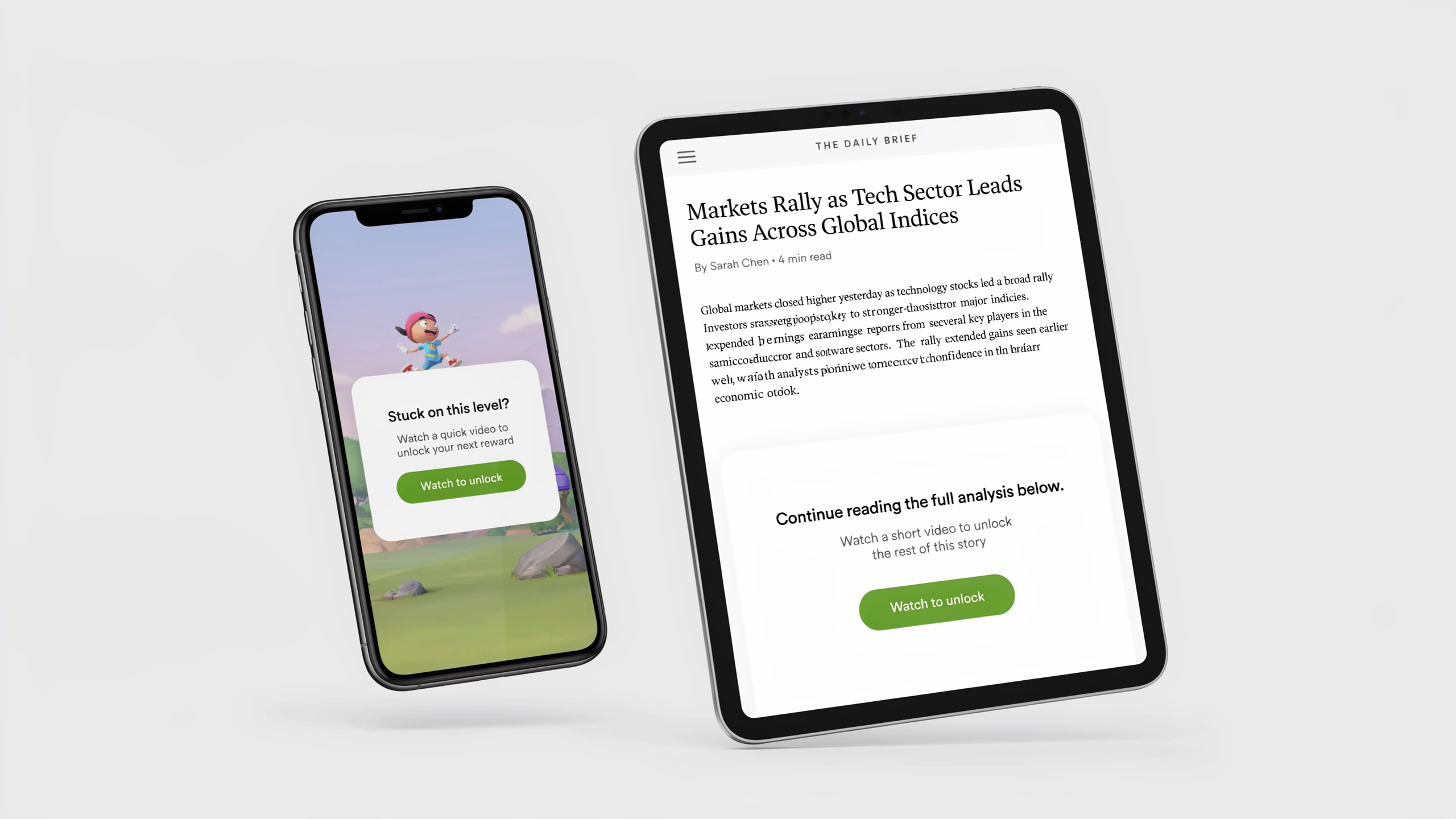
Rewarded ads are the closest thing mobile apps have found to a win-win. A user watches a short video and gets something back for it: an extra life in a game, an unlocked feature in a productivity tool, an extra credit in a subscription app. No one feels tricked and nobody blocks it.
On the open web, the same format barely registers. It makes up less than 1% of web ad revenue, even though the psychology behind it (attention traded willingly for something the user actually wants) works the same way on a browser as it does on a phone.
That gap is the story. The open web has spent a decade getting better at interrupting people: more formats, denser placements, cleverer ways to slip past ad blockers. The publishers who win the next decade will negotiate for attention as currency, instead of seizing it as inventory.
This is a third path, beyond more ads and beyond hard paywalls: a value exchange publishers control, priced in attention instead of dollars.
From Interruption to Exchange
The bluntest version of this model is familiar to anyone who has run a content site through the last decade of ad tech: a visitor lands, an ad fills whatever slot is available with no regard for what that visitor is actually doing on the page, and the visitor decides whether the interruption is worth enduring. Plenty install a blocker. Plenty just don't come back. Smarter, better-optimized placement has already closed a meaningful part of that gap, testing density and position per visitor instead of running one fixed configuration for everyone. What that still leaves out is reader consent. However well an ad is placed, the reader never chooses it.
Rewarded engagement closes that specific gap. The user gives attention. The publisher gives something back: premium content, a piece of utility, or a few minutes of calm. That's a trade, and readers experience trades differently than impositions.
Control is the distinguishing variable. Readers don't hate advertising as a category; they hate having no say in it. An ad they opted into feels like a decision they made. An ad forced on them feels like a tax on being there. This is why active, opted-in attention sits in a different value class than passive scrolling: advertisers pay a premium for engagement they know is chosen.
That premium only holds if the trade itself is calibrated. The cost of the ad has to match the value of what it unlocks. Ask someone to sit through a jarring interstitial for a lightweight convenience and the exchange feels lopsided. Ask for the same attention in return for something genuinely useful, and it reads as fair. Getting that calibration right, on a page-by-page and moment-by-moment basis, is the actual skill here. It's harder than it sounds, and it's exactly why most publishers haven't done it at scale.
Why the Web Still Trails Apps
If the value exchange model is this compelling on mobile, the obvious question is why it hasn't spread to the open web. A few structural reasons explain the gap.
Implementation has historically been hard. Rewarded ads need custom triggers, precise event tracking, a fallback plan when demand doesn't clear, and ongoing tuning as formats and demand sources shift, none of which most publishers can build with an in-house team. App developers building for a single platform had an easier path than publishers running across a patchwork of browsers and ad stacks.
Then there's the failure mode nobody likes to talk about: the empty slot. When a rewarded video bid doesn't clear, the ad space traditionally goes dark. That means zero revenue and a reader who did their part and got nothing back for it. One bad experience like that is enough to make a publisher shelve the format entirely.
Compounding both problems is a framing mistake. Most publishers who have experimented with rewarded formats treated them as a single ad unit rather than a conversion journey with distinct stages: the prompt, the start, and the completion. Optimizing only for the ad itself, instead of the full path a reader travels through it, leaves most of the value on the table.
And sitting behind all of it is a monetization gap that membership models haven't closed. Hard paywalls convert a fraction of visitors and bounce the rest. Pure free access leaves obvious revenue unclaimed. Publishers have been choosing between two blunt instruments because a sharper one hasn't been available to them.
The Opportunity: A Third Lane
Between the hard paywall and pure free access sits a lane most publishers haven't built yet: a soft on-ramp that runs from free access, through a rewarded unlock, to a paid membership skip for readers who'd rather not watch anything at all.
A few patterns make this work in practice.
The content bridge gates the deep-dive or the bonus layer, never the core news. Readers get the story; the rewarded unlock is reserved for the analysis underneath it, the extended data set, or the second half of an investigative piece.
The utility trade aligns the ask with the moment a reader wants something most: unlocking a tool's export function, revealing a calculator's result, or accessing a comparison a reader has already invested time building. Intent is highest right there, which is exactly where a rewarded ask converts best.
The experience upgrade treats an ad-light window as a loyalty reward rather than a paid tier. A reader who engages with the site regularly earns a stretch of lighter advertising, which reframes rewarded engagement as something that pays the reader back over time instead of asking something new of them every visit.
What ties all three together is a short list of conditions that determine whether any of them convert. Readers complete the exchange when the reward feels worth having, when the terms are stated plainly before they act, when the publisher delivers exactly what was promised, and when that delivery doesn't turn into a string of additional asks. Skip any one of those and the format collapses back into the interruption model it was supposed to replace.
The Infrastructure of Reliability
The fastest way to burn reader trust with this model is to borrow gaming's "extra life" mechanics and paste them onto an editorial brand that has spent years building credibility. Readers can tell when a mechanic doesn't belong, and an ill-fitting one costs more trust than it earns in revenue.
The deeper issue, though, is the empty-slot problem described earlier, and it's worth naming directly because it's the reason most rewarded products stall at pilot stage. Most rewarded ad products in the market today are all or nothing, built around a single video format with no plan B. If the top-tier video bid doesn't clear, the slot stays dark and the publisher earns nothing on an engagement the reader already showed up for. That gap between "we tried rewarded" and "rewarded actually works here" is almost always this one, and it's where most publishers give up on the format before it ever gets a fair test.
The fix is a Zero Waste Auction: instead of a single format with no fallback, the ad slot cascades automatically through a multi-format rewarded stack, moving from video to high-value display to outstream to interstitial until something fills. This is fundamentally what sets Ezoic apart in the market. Every single user engagement is monetized, regardless of whether the top-tier video clears. This is the meaningful gap between a rewarded ad unit bolted onto a page and rewarded ad infrastructure built to never waste an engagement, and it's the difference most publishers can't see until they've run both.
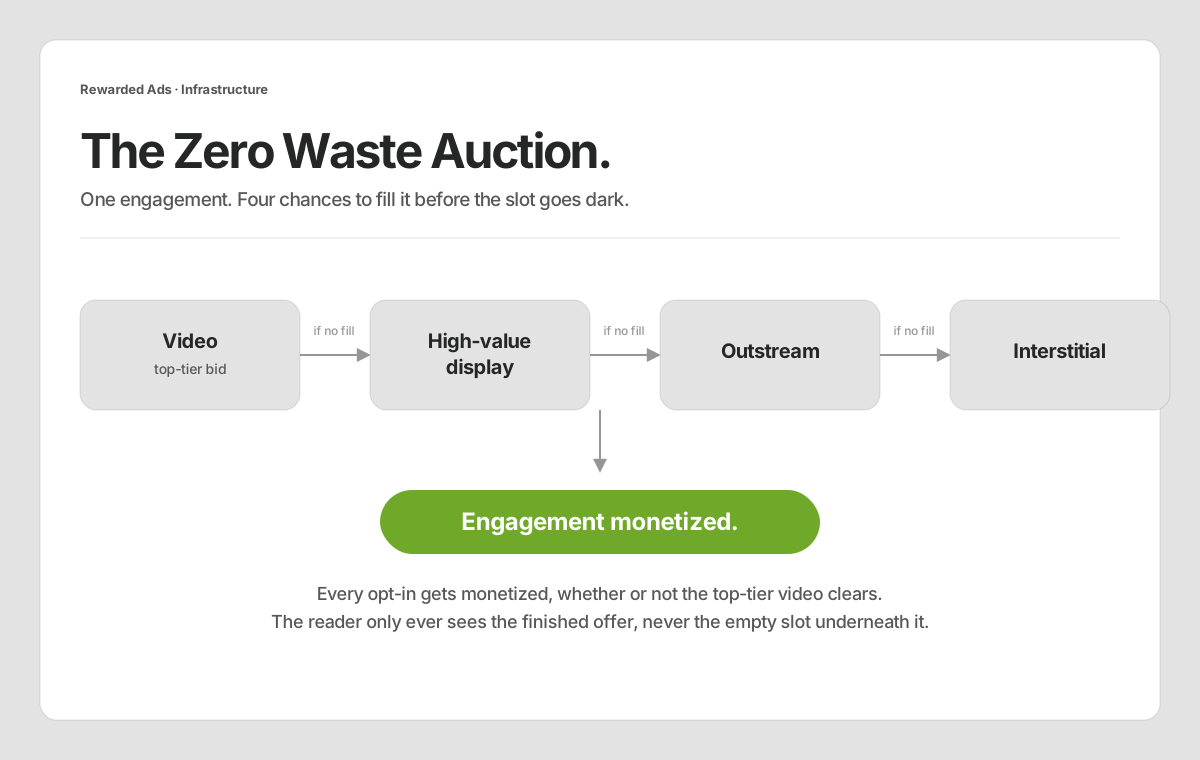
That shift depends on treating "rewarded" as a trigger, not an ad format. The moment of intent, the instant a reader opts in, is the asset. What fills that moment is a decision the system makes in real time.
Once rewarded engagement is treated as a trigger, the optimization target changes too. Instead of chasing the highest CPM on a single impression, the work shifts to the full funnel: prompt, start, completion. Publishers using platform-wide benchmarks across that funnel can push for real revenue lift without sacrificing the retention the format was supposed to protect in the first place.
None of this is visible to the reader, and it shouldn't be. Cooldowns and pacing limits work quietly in the background. So does the fallback logic that fills a slot the moment the top format doesn't clear. What the reader experiences is a clean offer. That invisible layer is what keeps the negotiation feeling like a negotiation instead of a nuisance. See how the multi-format rewarded stack works: Rewarded Ads Overview
Measuring What Matters
CPM was never built to measure a value exchange, and judging rewarded performance by it alone misses most of what the format is actually doing.
The more useful lens is session health: return visits and time spent in a session. Layer in how often a rewarded interaction eventually turns into a membership conversion, and the picture becomes a lot clearer. Those are the metrics that show whether the exchange is building a relationship or just extracting one more impression.
There's a second, quieter benefit. Every opt-in is a first-party signal about what a reader values enough to trade attention for, which matters more with every passing quarter of cookie deprecation and identity fragmentation. That signal feeds better content decisions and better targeting without asking a reader to hand over anything they didn't already choose to give.
Put together, rewarded engagement functions as a retention lever first and an incremental revenue source second, and it produces lift that standard display can't touch because it's converting attention that would otherwise generate nothing at all.
The Model Is Proven
The publishers who come out ahead over the next few years will be the ones who built the most honest exchange, the kind where a reader knows exactly what they're trading and gets exactly what was promised in return, instead of the ones still hunting for a clever way to interrupt.
Mobile apps proved the model years ago. What's changed is that the open web finally has the infrastructure to run it at the same level of reliability, without the empty-slot risk that kept most publishers from trying. And this is something that Ezoic has proven to achieve time and time again.
Explore the strategic framework for rewarded ads: Rewarded Ads Overview and review technical mechanics behind the multi-format fallback stack: Rewarded Ads documentation