
The Chartbeat Data Is Out. What the Numbers Actually Mean for Your Publishing Business.

No tier of publisher is escaping the search traffic collapse. New Chartbeat data published this week via Axios quantifies two years of decline across the full spectrum from independent blogs to major media operations. The headline numbers have focused on small publishers, but the full picture is more sobering, and the operational implications apply to every content-driven digital business trying to protect revenue in 2026.
What the Numbers Actually Say
Chartbeat's two-year analysis breaks publisher impact into three tiers:
- Small publishers (1K–10K daily pageviews): down 60% in search referral traffic
- Medium publishers (10K–100K daily pageviews): down 47%
- Large publishers: down 22%
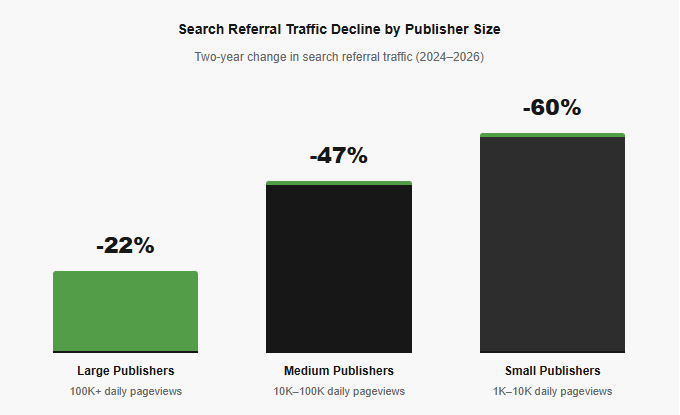
The 60% headline is generating the most coverage and rightly so. But the 22% decline for large publishers is not a rounding error, and the 47% for medium publishers is arguably the most underreported figure in this data. Each tier faces a different version of the same problem, and the right strategic response depends on understanding your specific exposure.
Large publishers have diversified revenue streams including subscriptions, events, licensing deals, direct advertiser relationships all of which buffer the total impact. They're still losing meaningful traffic, but their business models have more shock absorption. Medium-sized publishers operating content-driven businesses in the 300K–3M monthly pageview range tend to have concentrated exposure: search-optimized content operations, CPM-dependent ad monetization, and limited direct audience relationships. Small publishers were often running lean already. For digital business operators at any scale, the takeaway is the same: this is a clear and structural shift that demands a strategic response.
The AI Referral Myth
Before leaning on the "AI search will replace organic traffic" argument the data is unambiguous. According to Nieman Lab, ChatGPT referrals have grown over 200% year over year. They still account for less than 1% of publisher pageviews.
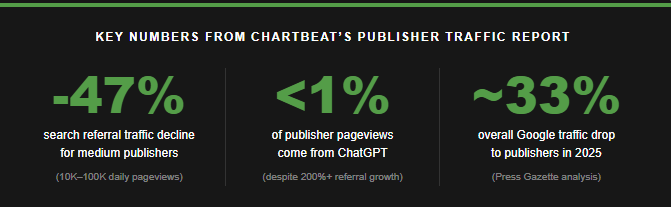
Traffic isn't moving from Google to AI search surfaces. It's disappearing altogether. AI overviews are answering queries directly on the search results page. Google traffic to publishers dropped roughly a third in 2025 alone, per Press Gazette's analysis. The audience that used to arrive at your site via a search query is increasingly getting its answer without clicking through at all.
This matters because the most common response to traffic decline is somewhere along the lines of "optimize for AI overview inclusion," "get cited by ChatGPT," and "build AEO into your content strategy." While reasonable it is unlikely to move the revenue needle in any meaningful way in 2026. The 200% ChatGPT referral growth sounds like momentum until you do the math on what sub-1% of pageviews actually represents in absolute sessions.
The Distinctive Challenge Facing Mid-Sized Operations
Every tier faces the traffic collapse differently and medium-sized publishers and digital business operators in the 10K–100K daily pageview range face a particularly concentrated version of the problem.
Large publishers have already been reckoning with platform dependency for years. Many have diversified into subscription revenue, events, and direct content licensing. Small publishers often built on minimal fixed cost structures. The medium tier is most likely to have:
- A content operation sized for search volume including editorial calendars, freelance budgets, and topic clusters built around keywords that no longer deliver the traffic they once did
- Ad monetization built on CPM volume, meaning a 47% traffic cut doesn't reduce revenue proportionally; it can push publishers below the thresholds that attract premium demand and better-quality programmatic buyers
- Limited first-party audience infrastructure like the subscriber lists, registered user bases, and direct relationships that make larger operations resilient to platform changes
Coverage from the Digiday Publishing Summit event last week reinforced this concept. Publisher executives across tiers described search decline as existential, not cyclical. M&A activity is already repricing publisher assets based on AI-era traffic baselines rather than 2022 peaks, signaling that the industry has accepted this is the new floor.
The Operational Question That Actually Matters
The dominant publisher response to traffic decline coverage focuses on the acquisition question: how do I get traffic back? How do I show up in AI overviews? How do I rank in ChatGPT? But that's the wrong question for 2026 for publishers at any scale.
The right question is: what is your revenue per session doing right now, and are you maximizing it?
If your traffic is down 22%, 47%, or 60%, chasing recovery through content volume bets is spending money you need to protect revenue on an outcome that isn't likely to materialize this year. The publishers and digital business operators who respond by auditing their monetization infrastructure are starting from the only premise that has a realistic near-term payoff.
What to Do About It
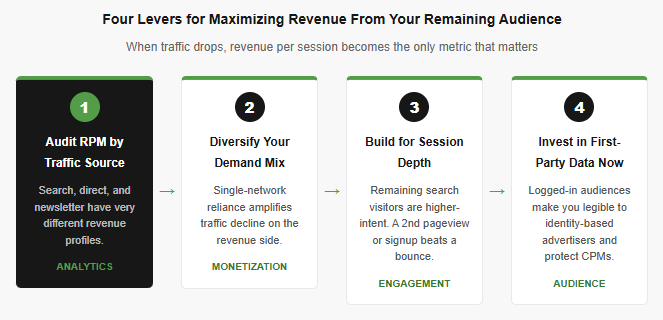
These four priorities apply whether you're a large publisher cushioning a 22% decline or a mid-sized operation absorbing a 47% cut:
Audit your RPM by traffic source: Search traffic, direct traffic, and newsletter traffic rarely have the same monetization profile. Understanding which audience segments are generating actual revenue (not just sessions) changes how you prioritize content and ad stack investments.
Diversify your demand mix: Single-network or single-channel ad revenue is structurally exposed when traffic volume falls. Publishers with multiple demand sources, direct relationships, and audience-targeted campaigns are better positioned to hold RPM even as total volume changes or declines.
Build for session depth, not just volume: The visitors still arriving via search in 2026 are increasingly high-intent. Lower-value navigational queries are being captured by AI overviews before they reach your site. Content that earns a second pageview, a newsletter signup, or a return visit compounds over time in a way that content optimized purely for top-of-funnel search volume doesn't.
Treat first-party data as an infrastructure priority: Publishers with email lists, registered users, and logged-in audience segments have the identity infrastructure that makes them valuable to advertisers doing audience-based targeting. That infrastructure is what separates publishers who hold CPMs from those who watch them compress as cookie-based targeting erodes.
How Ezoic Approaches This Problem
This is precisely the infrastructure gap Ezoic is built to close. Ezoic's AI-powered platform continuously tests and optimizes how ad inventory is served across every session, adjusting demand mix, ad configurations, and layout in real time to maximize revenue per visitor, independent of traffic volume. Rather than relying on a single network or static setup, Ezoic connects publishers to a broader pool of premium demand while running ongoing multivariate testing in the background.
For publishers managing traffic declines at any tier, that distinction matters: the monetization layer should be working harder as volume drops. Ezoic's platform is designed to protect and grow RPM even when overall session counts aren't growing which, in the current environment, is the only kind of revenue resilience that's realistic.
The Bigger Picture
The AdExchanger headline called it plainly: "The AI Search Reckoning Is Dismantling Open Web Traffic — And Publishers May Never Recover." That framing is blunt, but the Chartbeat data supports it. This isn't a recoverable dip across any tier. The industry is recalibrating around a new baseline.
The publishers and digital business operators who come through this period in stronger shape are the ones who stopped optimizing their business model for 2022 traffic levels and started building for the audience they actually have in 2026. That shift requires different questions, different metrics, and different infrastructure investments than the ones that drove growth during the peak search era. It's also the only path that has a realistic chance of working.