
Google’s Agentic Buying Stack Is Here - So What?

At last month’s NewFronts, Google made something official that's been in the works for awhile: Gemini is now the operating layer of DV360, which is not to be mistaken as a simple bolt-on feature. Advertisers can upload a media plan and the AI builds the entire campaign. It manages live sports inventory in real time. It reaches 96% of ad-supported CTV households. Google intentionally announced this update as a structural shift in how programmatic buying works in modern times.
Most of the coverage focused on what this means for buyers. That’s understandable. But if you’re a publisher, there’s a more relevant question to consider: where do you fit in a world where AI is doing the buying? The answer is buried in an announcement that didn’t get nearly enough attention.
The Piece Most Publishers Missed
At the same NewFronts, Google introduced Confidential Publisher Match, which is a next-generation identity model for connecting advertiser first-party data with publisher streaming signals. Roku was named as the first publisher partner. The underlying mechanics build on PAIR (Publisher Advertiser Identity Reconciliation), Google’s open protocol that’s been gaining adoption since the IAB Tech Lab standardized it in 2024.
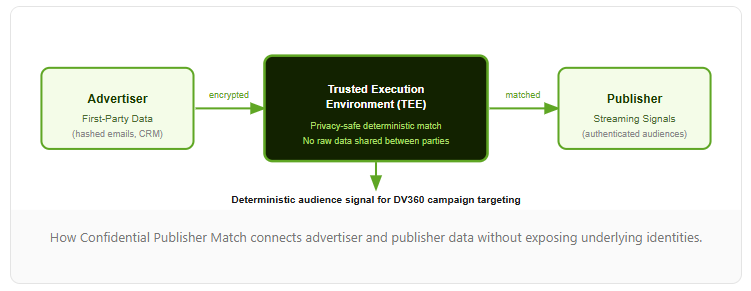
Here’s how it works: instead of relying on third-party cookies or probabilistic matching, Confidential Publisher Match runs deterministic identity reconciliation inside a Trusted Execution Environment. Both sides, the advertiser and the publisher, contribute their first-party data. The match happens in a privacy-safe enclave. Neither party sees the other’s raw data. What comes out the other side is a reliable signal that lets a buyer reach their customer on your inventory and trace the path from a CTV impression to a conversion.
The “confidential” part isn’t marketing language. The encryption and key structure make it significantly harder to reconstruct underlying identity data compared to earlier clean room approaches, even with deliberate effort.
What This Actually Changes for Publishers
Confidential Publisher Match changes the thought process. If your inventory is matchable, meaning buyers can reliably connect their first-party data to your audience, your inventory becomes categorically more valuable inside DV360. Advertisers running agentic campaigns through Gemini need deterministic identity signals to close the measurement loop. They’re buying outcomes, and publishers who can support that are a different product than publishers who can’t.

First-party data investment now has a direct monetization argument. The infrastructure to activate it at scale is being built right now.
Who’s Positioned to Benefit
Confidential Publisher Match, as currently structured, favors publishers with a few specific characteristics:
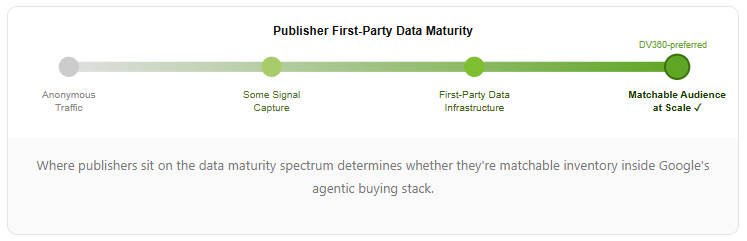
- Publishers with logged-in users or consistent email capture. Deterministic matching runs on real identity signals, such as hashed emails and authenticated user IDs. If your audience is entirely anonymous, there's nothing to match against. Publishers with registration walls, newsletters, or any mechanism that captures first-party signals at the user level have a structural advantage here.
- Publishers at meaningful scale. Google's rollout with Roku as its first named partner signals that this infrastructure is, at least initially, optimized for large-reach publishers. For independent publishers, the question isn't whether participation is possible, because the PAIR protocol is open and increasingly available through intermediaries. The question is whether your audience is large enough and well-defined enough to be worth matching against.
- Publishers with data quality, not just data volume. A million monthly visitors who are anonymous is a weaker match asset than 300,000 monthly visitors whose behavior and identity you've built a real data model around. Quality matters as much as quantity.
Where Ezoic fits into the mix: Ezoic's platform is built around structured audience data collection and activation at the publisher level, giving independent publishers access to the same kind of first-party data infrastructure that has historically required enterprise-level resources to build. For publishers already on Ezoic, the groundwork for moving up this maturity spectrum is already largely in place.
The Practical Question: What Do I Do Now?
If you’re a publisher seeing 250,000 users visit your digital property regularly and you haven’t built a meaningful first-party data strategy yet, the urgency looks different now. Buyers are being handed an AI-powered buying tool that rewards inventory where deterministic matching is possible, and Google is building the infrastructure to make that matching work at scale.
A few concrete things worth evaluating:
- What identity signals do you currently capture? Look at your email list, registration data, newsletter subscribers, and any account-based products. Anything that creates a hashed email or user identifier is a potential match asset.
- How is that data structured and accessible? Raw data you can’t activate is worth nothing in a match environment. If your first-party data sits in disconnected systems with no clean export or activation layer, the infrastructure question is as important as the data collection question.
- Are you or your ad stack connected to PAIR-compatible environments? This is increasingly worth raising with your SSP or monetization partner. The protocol is standardized. The activation pathways are not all equal.
Ezoic has been actively building toward this. The platform's data infrastructure and monetization tooling are designed to help independent publishers activate audience signals in exactly the kinds of programmatic environments this shift rewards so publishers on Ezoic aren't starting from zero on any of these questions.
The broader arc here is one Google has been building toward for a long time: a closed-loop buying environment where their DSP, their identity infrastructure, and their AI planning layer all work together. Publishers who fit cleanly into that infrastructure will command premium from the buyers running inside it.