
Ezoic Conversion Pixel: How Publishers Can Tell Ad Platforms What a Visitor Is Worth


Meta, Google, and Microsoft are exceptionally good at one thing: optimizing toward conversions. Feed their algorithms a purchase, a signup, a qualified lead, and Smart Bidding or Advantage+ will go find you more of exactly that. It's the entire premise of modern paid acquisition.
Ad-funded publishers don't have that conversion. There's no checkout, no signup form, no CRM event to fire back into the platform. What publishers have is ad revenue — earned in aggregate, across thousands of page views, in dollar amounts that vary wildly from one visitor to the next.
So publishers improvise. They feed the platforms a proxy — a pageview, a session, a minute of time on site — and hope the algorithm treats it as a stand-in for value. However, the platforms can only optimize toward the signals you provide. The algorithm does exactly what it's built to do: it chases more of the proxy. Not more revenue. More pageviews, more sessions, more of whatever event you told it to count.
That gap is where paid acquisition budgets can become inefficient. A publisher can run a technically flawless campaign — tight targeting, clean creative, disciplined bids — and still see poor returns, because the platform has no idea which visitors are worth $10 in ad revenue and which are worth a tenth of a cent. It's optimizing based on limited data, and it's doing so at scale.
Why "cost per pageview" was never going to work
A single pageview on a content site might generate $0.001 in ad revenue. It might generate $10. The difference comes down to the visitor — their geography, their device, their intent — and the content they land on. That range isn't a rounding error; it's the entire economics of the business.
Smart Bidding and Advantage+ are built to optimize toward a value signal. Give them one, and they get relentlessly good at finding more of it. Give them a proxy instead, and they optimize toward the proxy just as relentlessly — pageviews, sessions, time on site — none of which map cleanly to revenue.
Without a real value signal, spend doesn't naturally drift toward the most profitable traffic. It drifts toward the cheapest traffic that satisfies the proxy. Those are rarely the same audience.
Introducing the Predictive Conversion Pixel
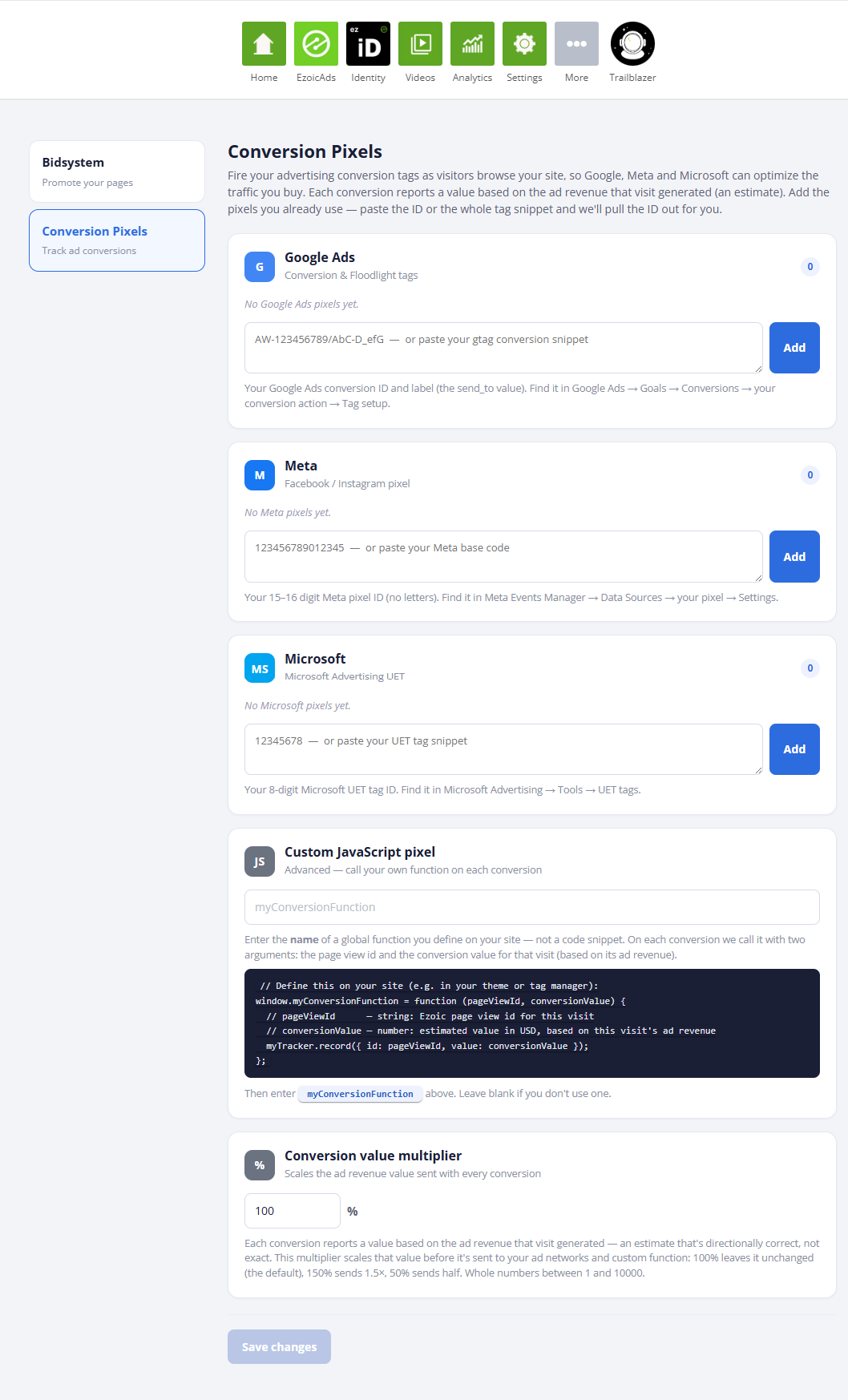
The Predictive Conversion Pixel lives in the User Acquisition section of the Ezoic dashboard, built specifically for publishers who buy traffic. Connect a Google, Meta, or Microsoft pixel — or a Custom Pixel of your own — and Ezoic fires it the moment a visitor lands, with a predicted dollar value of what that specific visitor is expected to generate in ad revenue.
That's the shift. Instead of telling the platform "this was a pageview," you're telling it "this pageview was worth $6.40." The platform now has an actual value signal to optimize toward — the same kind of signal an ecommerce site sends on every purchase — built for a business model that doesn't have a checkout button.
Setup is dropdowns and toggles. No CAPI implementation or engineering submission requests. If you can connect a pixel today, you can connect this one.
How the prediction actually works
Because Ezoic runs the ad stack, we've seen the actual auction outcomes for billions of similar visitors—and we use that data to predict what this specific visitor is worth the moment they land.
That said, the number the pixel fires is a prediction, not an audited receipt. It can vary somewhat by geo, domain, and ad format. What it does reliably is get the direction and magnitude right by distinguishing a genuinely high-value visitor from a genuinely low-value one, consistently enough for the algorithm to learn from. That's the bar that matters. Smart Bidding doesn't need a receipt; it needs a signal it can trust across thousands of visitors, and directionally accurate is what makes the learning compound.
What this looks like in practice
As an illustration, consider a hypothetical publisher averaging $15 EPMV. Running a paid social campaign at a $12 CPM, they're pulling in traffic that actually converts to $8 EPMV once it hits the site. Without a value signal, the platform keeps buying more of the same audience and the campaign looks fine on the surface, but the publisher is losing money on every thousand visitors, with no way to see it happening.
Add the pixel, and the platform learns something it didn't have before: this pool of visitors is worth $8, not $15. It reallocates spend toward sources that behave like the campaign's actual best traffic with visitors converting closer to $22 EPMV. Same budget. Same CPM discipline. A meaningfully different outcome, because the platform is now chasing the number that actually matters.
Who this is built for
This is purpose-built for publishers running paid acquisition to grow: paid social and paid search operators scaling traffic deliberately, arbitrageurs buying traffic to monetize and reinvest, high-volume niche sites — recipe, listicle, utility content — where visitor value swings hard by source, and newsletter or community builders paying to grow a subscriber base. If ad revenue funds your growth loop, and you're buying any of the traffic that feeds it, this is the gap the pixel closes.
Best practices for getting this right
- Normalize your bidding. The pixel is a directional estimate, not an audited number. If you find the pixel is consistently under- or over-reporting relative to your actuals, use the percentage adjustment tool on the page to align the signal. This allows you to fine-tune the signal directly, without waiting on a data science project.
- Send traffic to content, not homepages. A deep article or listicle carries a far richer revenue signal than a root URL. Point campaigns at the pages that actually earn.
- Give the algorithm room to learn. Plan for 5,000–10,000 clicks before the platform converges on the new signal. Judging results before that point is judging noise.
- Change what you watch. Cost-per-click in isolation is the wrong scoreboard. A basic concept: $0.60 CPC source generating $25 EPMV beats a $0.20 CPC source generating $2 EPMV every time — and CPC alone will never show you which is which.
Common questions
I already run paid campaigns — why do I need this? The pixel doesn't replace your media buying; it makes the spend you're already committing more effective, by replacing a proxy metric with an actual revenue signal.
Isn't a conversion just a pageview for a publisher? That's exactly the problem it solves. A pageview's value isn't fixed — it ranges from a fraction of a cent to double digits. The pixel tells the platform which pageview it's looking at.
How is this different from Google's value-based bidding? Value-based bidding typically assumes a conversion event (like a purchase) to attach a value to. The Predictive Conversion Pixel gives ad-funded publishers a value signal without needing a traditional conversion event, firing the value the instant the page loads.
Stop bidding blind. Set up the Predictive Conversion Pixel in the User Acquisition section of your Ezoic dashboard and start feeding Google, Meta, and Microsoft a real revenue signal instead of a proxy.