
Coverage Is a Vanity Metric: Why Deterministic Identity Matters Most


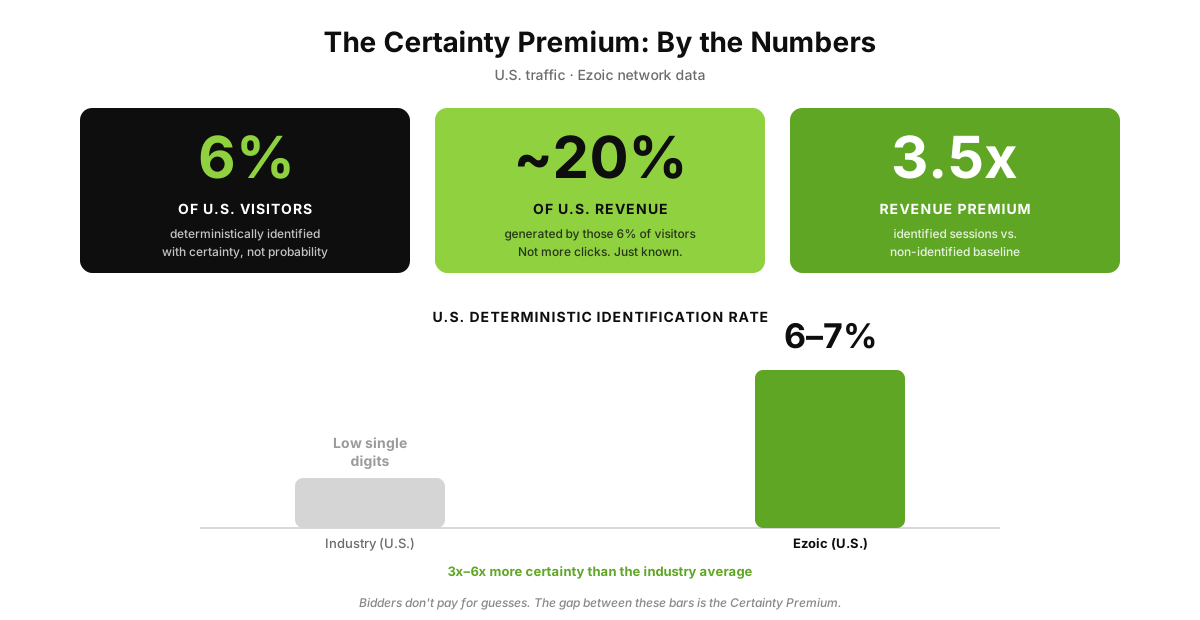
There’s a Pareto principle at work in Ezoic’s U.S. traffic and it runs more concentrated than the classic 80/20 rule. Roughly 6% of U.S. visitors generate nearly 20% of total U.S. network revenue. These aren’t traditional power users: they don’t browse more pages, click more ads, or linger longer on sites. The only variable that separates them from the other 94% is that they are deterministically identified meaning that they are known with certainty, not inferred from probability.
Call it the Certainty Premium. That 6% figure is worth pausing on. Deterministic identification is genuinely hard to achieve at scale. It requires a real first-party signal through a verified email, a hashed identifier, or a consented login, rather than a probabilistic inference built from device behavior and shared browsing patterns. Most programmatic traffic runs on guesses. Deterministic identification rates in U.S. markets remain in the low single digits across the industry; Ezoic’s U.S. rate runs at 6–7%. That’s 3x to 6x more certainty than publishers typically receive from an ad management partner, and it’s why identified sessions command a 3.5x revenue premium over non-identified baseline.
“Coverage” which is the metric most ad tech platforms lead with, is not the same thing. Bidders pay significantly more for certainty these days. Everything that follows is an explanation of how that certainty gets built into infrastructure, and why the coverage number your vendor is selling you probably doesn’t mean what you think it does.
The industry’s language problem
“Coverage” and “authenticated traffic” are used interchangeably across ad tech from vendors to publishers themselves. In reality, they are not the same thing. It directly determines what advertisers are willing to pay. Here’s how to keep them straight:
Authenticated traffic is the percentage of your visitors a platform knows with certainty. This could be through a login, a hashed email (a privacy-safe fingerprint derived from an email address) hashed phone number, or a deterministic identifier. Authentication happens at the edge, before any auction starts. It’s where certainty lives.
Coverage (or match rate) is a downstream measurement: the percentage of those visitors a given DSP, SSP, or identity graph can also recognize in its own database. This happens at the bid request, after identity is already in play.
The relationship between the two is where most publishers get misled. A platform can have 100% authenticated traffic and still carry a 40% match rate with a specific DSP if that DSP’s database is incomplete. Conversely, a platform can report 80% “coverage” built almost entirely on probabilistic guesses and buyers price that uncertainty into every bid. The ceiling for probabilistic coverage is a discount. Deterministic certainty, extended through the right industry partnerships and proprietary infrastructure, is where the premium lives.
Think of it this way: authentication is showing your ID at the door. Coverage is the credit bureau check that happens afterward. The first is certainty. The second is reach. Both matter but only one drives the revenue premium.
What happens inside the auction
DSPs and programmatic buyers bid on what they know. When a deterministic identifier arrives in a bid request, a buyer can price that impression accurately. They know who the user is, what they’ve purchased, what they’re likely to buy next, and how much that user is worth to a specific advertiser at this moment. The bid reflects all of that.
When a probabilistic signal arrives, the buyer discounts and the bid reflects uncertainty. A guess is worth less than a guarantee, every time. This is why the revenue multiplier exists. Ezoic’s deterministic traffic commands a 3.5x revenue premium over non-identified baseline sessions. That’s the market telling you, directly and precisely, what certainty is worth to a buyer at scale.
But what does it take to build that certainty at scale? Let’s break it down into three components.
How Ezoic’s identity stack actually works
Layer 1: The Deterministic Core: ezID
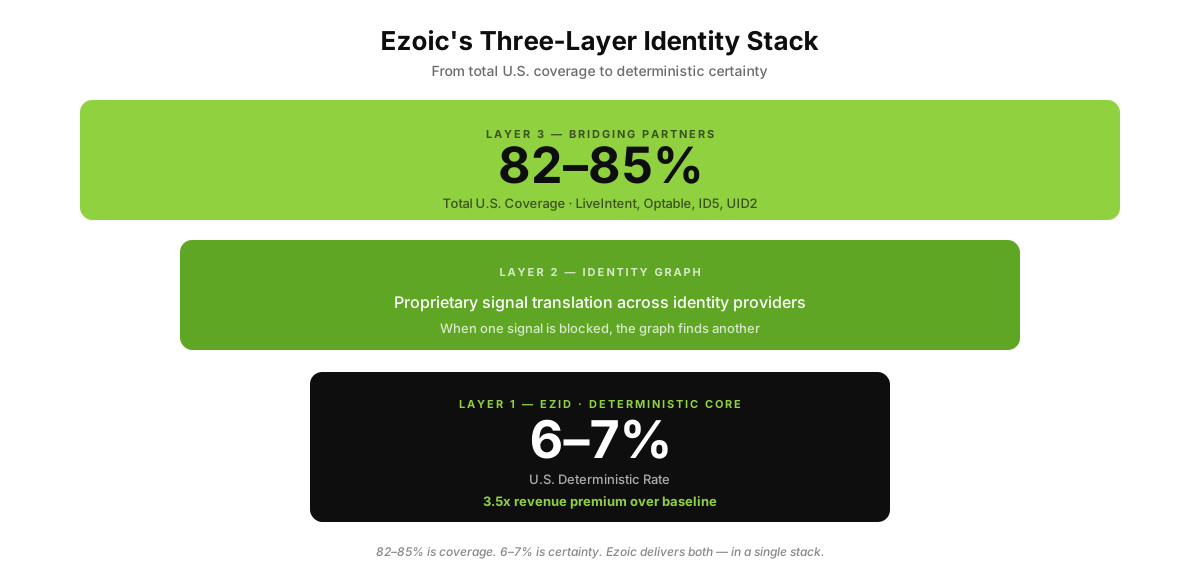
This is where 100% confidence identification happens, via hashed emails and/or phone numbers and verified first-party signals. Every impression in this tier is known with certainty which means no guesswork injected before the bid.
This is also the layer most ad platforms don’t have. Deterministic identification rates in U.S. markets remain in the low single digits across the industry. Ezoic’s deterministic rate runs at 6–7% of U.S. sessions which equates to 3x to 6x more certainty than a publisher typically receives from an ad management partner.
The distinction worth making explicit: most platforms pass through a third-party ID. Ezoic owns the deterministic relationship. ezID is not a feature layered on top of the platform. It is the platform’s identity infrastructure. And it’s the layer generating the 3.5x multiplier.
Layer 2: The Identity Graph
A proprietary translation layer connecting different identity signals across the programmatic ecosystem. When one ID provider is blocked either by a browser privacy setting, a consent choice, or a jurisdiction-specific rule, the graph finds an alternative signal and maintains a continuous identity thread.
Without a graph, each identity partner operates in isolation. Signal loss in one channel becomes a lost impression. With it, the system is resilient. Loss in one channel doesn’t cascade through the rest.
Layer 3: Bridging Partners: The Reach Layer
Integrations with market leaders and identity focused businesses extend identity resolution beyond the deterministic core. These signals are injected at the bid request via Prebid, enriching non-authenticated impressions across the full publisher footprint.
This is how the 6–7% deterministic core expands to 82–85% total U.S. coverage demonstrating that nearly every impression becomes addressable. Publishers aren’t only capturing premium pricing on their best traffic but they’re getting addressable pricing on almost all of it.
The critical distinction to keep in focus: 82–85% is coverage. 6–7% is certainty. Ezoic delivers both, in a single stack. Most competitors deliver one or the other and call it identity.
The CFO case
ezID-identified visits represent approximately 6% of total U.S. network traffic. They generate nearly 20% of total network revenue.
That ratio is only possible if deterministic identity is commanding a structurally different price per impression. The 3.5x multiplier isn’t averaged across all traffic. Instead, it’s a concentrated lift at the top of the identity funnel. A publisher who improves their deterministic rate doesn’t just improve a metric. They disproportionately improve revenue per visit, which is the efficiency number that matters when traffic is under pressure from AI search, organic volatility, and zero-click results.
This played out clearly across Ezoic’s network in Q1 2026 where EPMV climbed 27% and by late March, saw a 38% improvement within a single quarter. More money with less traffic. That’s what identity-driven yield optimization looks like when it’s working.
Coverage is a vanity metric
Coverage is easy to inflate. A probabilistic match where an identity graph infers who a user might be based on device signals and browsing behavior counts as “covered” in most vendor reporting. The number looks impressive. The revenue impact doesn’t match it, because DSPs price the difference between a deterministic signal and a probabilistic one into every bid, automatically, every time.
Coverage is a vanity metric. A 60% probabilistic match rate is a guess. A 6% deterministic authentication rate is a guarantee. The right question to ask any identity vendor isn’t “what’s your coverage?” It’s “what percentage of that coverage is deterministic?” And: “what revenue multiplier do your identified sessions actually command?”
Final thoughts
Traffic is under pressure and it’s not letting up. AI search is compressing organic reach; signal loss is shrinking the addressable pool. The publishers who hold their revenue through it won’t be the ones with the highest coverage numbers. They’ll be the ones who are built around certainty and who can prove to a buyer exactly who their audience is. Fewer visits doesn’t have to mean less revenue. That’s what the 6% is telling you.