
AI, Auction Obfuscation, and What's Actually Changing for Publishers: John Cole on New Digital Age
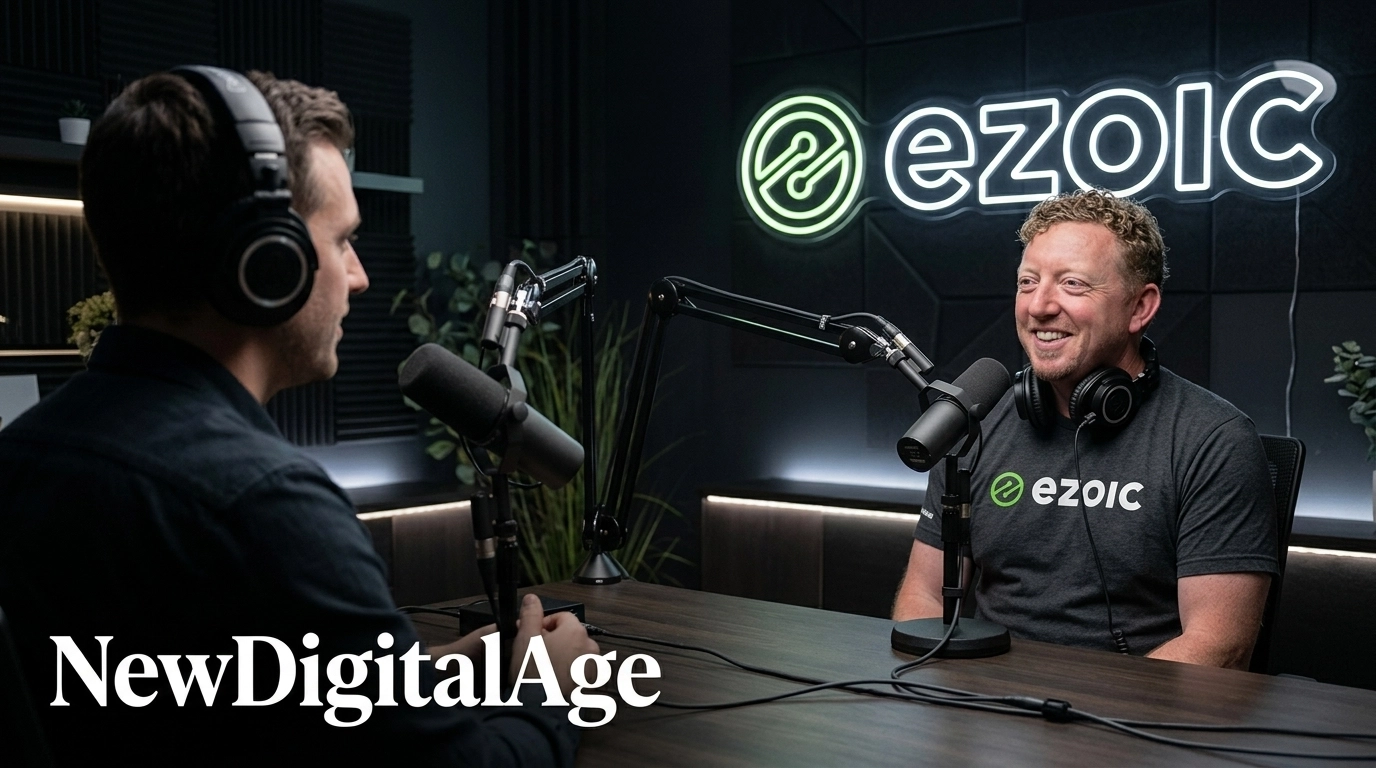

A recap of Ezoic Chief Customer Officer John Cole’s conversation with Justin Pearse on New Digital Age and the accompanying NDA Podcast episode — May 2026.
Fifteen years is a long time to watch the same problems persist in digital advertising. Long enough to see the same supply chain take the same slices, the same auction dynamics get more opaque rather than less, and the same publishers get squeezed between platforms that grew up around them.
In a recent interview with New Digital Age, Ezoic’s Chief Customer Officer John Cole sat down with Justin Pearse to take stock of what has actually changed for digital publishers and, more interestingly, what hasn’t. The full conversation is also available on the NDA Podcast.
Cole’s read on the industry is a useful one to publish here for two reasons. He has been close to the publisher business for over a decade, including through Ezoic’s evolution from a multivariate testing tool into one of only a handful of Google Premier Certified Publishing Partners globally. And he is, in his own words, “cautiously optimistic” which is a voice the industry could use right now.
Roughly 10,000 publishers and around 800 million monthly visits run through the Ezoic platform today. The conversation Cole had with NDA is grounded in what those publishers are actually telling him.
The structural problem hasn’t disappeared
Cole is direct about what hasn’t changed. The long-standing power imbalance between publishers and the rest of the supply chain is still largely intact. Agencies, sales houses, SSPs, ad servers, and assorted intermediaries each take a slice before revenue reaches the publisher. As he put it:
“One side knows more about the value of your users than the other, and so they can pick it up more cheaply than they should. We aim to help fix that.”
The auction itself has gotten harder to read, not easier. Cole references public comments from The Trade Desk’s Jeff Green about obfuscation in the programmatic auction process, and points to specific techniques he sees in the wild including seller duplication, where a single ad request gets replicated tens of times to chase the highest bid. (Cole was clear that Ezoic does not use these techniques.)
The pain points he hears from publishers in 2026 sound like the pain points he heard in 2016: poor revenue transparency, private-marketplace deals arriving with poor tracking, ads.txt files bloated with resellers, and data fragmented across too many systems and partners. “There is just too much adtech in the ecosystem,” Cole said. “What publishers want is clarity. They have high-quality traffic and they could get paid much more if they leverage better technology to untangle all the inputs.”
Traffic is not a strategy anymore
The structural backdrop is one reason Ezoic has reshaped its book of business over the last few years. As Cole notes, more than 75% of all searches now stay on Google due to AI Overviews. Users are reaching the open web less, and SEO traffic is no longer the durable foundation it once was for businesses building on the open internet.
Ezoic has responded in two specific ways. First, the platform raised its publisher minimum to 250,000 monthly visits in February serving as a deliberate move toward digital businesses with the audience footprint to take advantage of full-stack revenue infrastructure. Cole was candid in the interview about why: smaller sites that earned $4 when they hoped for $5 would sometimes leave a negative review and move on, and that reputational noise made it hard to tell the fuller story to the audience Ezoic is now built for.
Second, the platform has actively expanded into surfaces that don’t depend on a Google ranking at all — newsletter publishers, web apps, online directories, email service providers, and other “destination” properties where users arrive with intent. Cole reports steady 25% year-over-year growth in this part of the business.
The underlying thesis is consistent with what the rest of the industry has started to acknowledge but few are acting on: revenue compounds through engagement, identity, and first-party data — not raw pageview counts. Platform-wide identified revenue across Ezoic grew 6x year-over-year in 2025, with sites using ezID seeing 15%+ EPMV lift on identified traffic and 110%+ improvement on U.S. identified users. An email address is, simply, worth far more than a cookie ever was.
Where AI is doing real work
LLM-driven development, Cole said, has changed how quickly Ezoic can build. The result, in practical terms, is that the platform can offer mainstream newspapers and mid-tier publications bespoke solutions instead of one-size-fits-all integrations.
“Software can become more bespoke now for publishers. They don’t have to be the same as everyone else.”
That same shift has shown up inside Ezoic’s own operations. Publisher success teams write natural-language queries against a database and get instant answers. Cole and his publishers receive automated daily reports (e.g. earnings, identity revenue, video versus display splits, bid floor trend lines) generated by Ezoic’s internal AI agents.
On the revenue side, Cole highlighted Ezoic’s rewarded advertising format as a more sustainable alternative to a hard paywall. Modeled on opt-in mechanics familiar from mobile gaming, it invites a reader to watch a short video in exchange for access to an article. The reader gets the content. The publisher earns ad revenue. The advertiser reaches an engaged, opted-in user instead of a hostile one. As Cole framed the moment publishers are in:
“Publishers are in a conundrum. Google’s latest advice is to add value with content or services that are unique, to avoid commoditized content; they have to add value outside of easily found, general information.”
Rewarded formats are one of several places where the economics start to favor publishers with real audiences over the long tail.
The takeaway
After 15 years, the structural problems for publishers are stubbornly familiar. What’s different — and where Cole’s optimism comes from — is that the tools to address them at speed and at scale are arriving in real form. Faster product cycles. Smarter identity. Opt-in monetization formats. Analytics that actually surface revenue per page, audience segment, and traffic source instead of leaving it buried.
The full New Digital Age interview is available here, and the accompanying NDA Podcast episode, featuring John alongside coverage of Possible Miami and retail media growth is available on Spotify.